
Stranger Things: What the First Four Seasons Got Right
A quick tour through the elements that shaped the first four seasons.

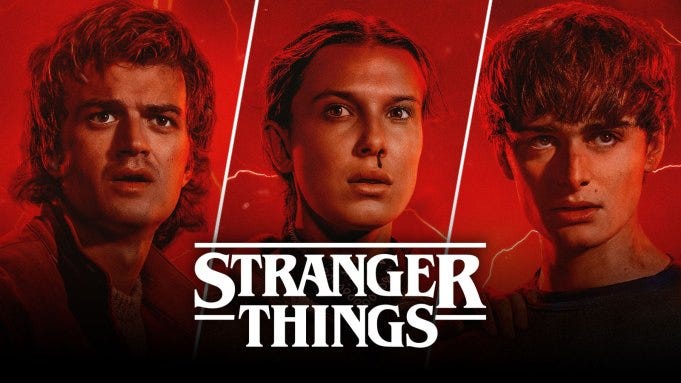
Over the last decade, Stranger Things has earned its place as one of the strongest modern American shows. The creators have proven again and again that they know how to tell a story. Season 1 was good, and instead of hitting the usual second-season slump, which they ought to have done, the show only sharpened its momentum. They built on what worked and made it better.
Last week, I promised an article about whether Season 5 holds up against the first four seasons. I did write that article—and it turned into 4,000 words! Even the most enthusiastic readers probably aren’t ready for that on a Friday afternoon. So this week is part one, and next week will be part two.
For now, I want to look at what the show has consistently done well. This isn’t a deep dive; each of these points could be its own article. Think of it as a high-level snapshot of the ingredients that made Stranger Things such a standout series.
1. The Story: Reliable, Tight, and Satisfying
The showrunners know their recipe. Every season follows a familiar structure, but it never feels stale. Each episode moves with intention. They’ve found a formula that works, and they use it without slipping into formulaic storytelling. Formula that’s not formulaic. That’s what good storytellers do.
2. The Characters: Community First
I don’t love every character decision the show has ever made, but I want to zero in on two things the show gets absolutely right.
They show characters in community, not isolation
This is a huge departure from the standard American storytelling model, which obsessively focuses on individuals. In most shows, the individual is the story; everyone else is support furniture.
Stranger Things flips that. Every character is defined within a larger community—friends, families, neighbors, adults, teens, kids. It’s not that there are no individual strengths but the individual strengths only make sense because of the roles they play within this web of relationships.
The show is cross-generational
This might not sound like a big deal at first, but it’s incredibly rare in modern stories. Most stories pick an age group and stick with it. In a kid’s story, if adults appear, they are often background noise.
In Stranger Things, adults matter. Teens matter. Kids matter. Their storylines overlap and depend on one another. It’s one of the reasons the show feels richer and more grounded than most things in the mainstream.
3. The Fairy-Tale Layer
You knew this was coming.
Again, there’s a lot to say here, but I’ll stick to two essentials.
The Upside Down is always right there
The show presents the Upside Down as something that exists alongside normal life. It’s as real as Walmart. It frames the tension between hyper-rationalism and an enchanted world of unseen realities, creating a believable balance.
Honestly, I think the iconic ‘80s nostalgia is so successful because of the fact that it’s set against this fantastical backdrop. The ordinary becomes charming within the context of the extraordinary.
A world with heroes and villains
Every season opens by naming the villain through a D&D motif—clever, simple, and symbolic. But beyond that, the show treats evil as real. Something is out there in the dark, and it won’t stop unless someone stands up to it.
Which leads to the heart of this article of what I want to highlight.
4. The Heroes: Classic Fairy-Tale Heroes
This might be the most important point.
The heroes in Stranger Things are classic fairy-tale heroes. In fairy tales, the hero is never special in the way modern stories think of “special.” They’re ordinary, everyday people who could be any of us. That’s why an elf never could have taken the journey to Mordor. It had to be a hobbit.
It’s not that the hero does not have skills, strengths, and resources. But those traits sit inside the framework of normal life. They’re relatable. They have flaws. They make mistakes. They’re brave because they have to be, not because there is something innately special about the individual.
This ordinary-hero approach is a big part of what makes the early seasons work.
A Hint at Season 5
And here’s where I’ll leave you for now.
In Season 5, I think the show breaks from this pattern—and not in a good way.
We’ll talk about that next week. Stay tuned for part two.
I haven’t watched an episode, but will check it out for sure. I’ve always admired your synopsis, you’ve always done a wonderful job of not just analysis, but also putting the pieces back together. It has really helped me explore some things I would never have before
Hey! Subscribed
I write reviews of the first episodes of nostalgic tv shows to help you decide what to watch next!
Check out my latest review of the first ever episode of Stranger Things!✨
https://open.substack.com/pub/thepilotroom/p/stranger-things-pilot-review?r=6vbi6l&utm_medium=ios